
menu engineering is a practical business issue for Australian hospitality operators, not simply a search term or a one-off project. A menu can be popular and still underperform if recipe costs are outdated, preparation is too complex or high-margin items are difficult to find. A disciplined review combines sales data with recipe costing and operational reality so that pricing and product decisions support the concept instead of weakening it. This guide explains how to approach the decision with clear commercial, people and service outcomes in mind.
Related priorities often include restaurant menu analysis, food cost control and menu profitability. They matter because the result must work in a real venue, event or support team where time, labour, supplier capacity and guest expectations all interact.
- The commercial reason to act
- A five-point diagnostic
- An implementation roadmap
- Measures and common mistakes
- A practical checklist
- Frequently asked questions

Why menu engineering Deserves a Commercial Review
Menu engineering is the structured analysis of item popularity and contribution margin. It looks beyond food-cost percentage alone by asking how many units sell, how much gross profit each sale contributes and what the dish requires from purchasing, preparation and service. The result is a set of evidence-based decisions about placement, description, price, portion and product mix.
The objective is a menu that guests understand, the kitchen can execute consistently and the business can sell profitably. That requires an honest baseline, decisions that reflect current operating conditions and a method the team can maintain after the initial project. A useful review connects the customer proposition with costs, capacity and day-to-day execution instead of treating each area separately.
A Five-Point Diagnostic for Better Decisions
Use Current Recipe Costs
Cost every ingredient in the standard portion, including garnishes, sauces, cooking loss and significant packaging. Supplier prices and yields change, so a recipe cost that was accurate six months ago may now create a misleading margin. Use current operating data rather than assumptions, and confirm who owns the decision after the review.
Measure Popularity and Contribution Together
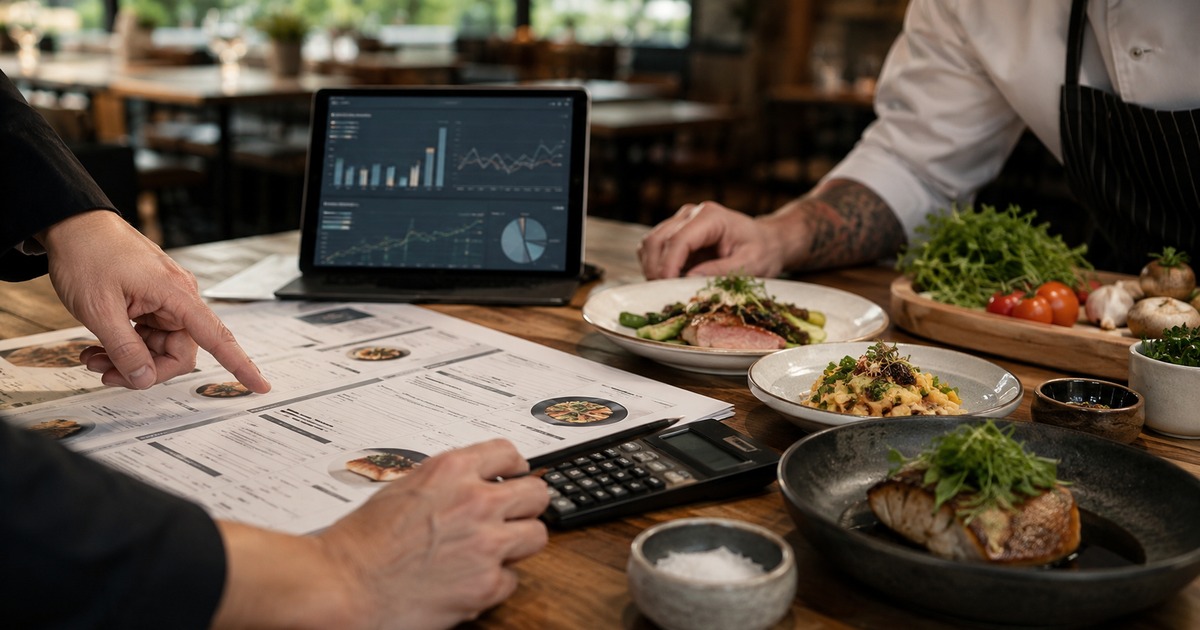
Export a representative sales period and calculate contribution margin in dollars, not only percentages. Classifying items as high or low on both popularity and contribution reveals stars to protect, puzzles to reposition, ploughhorses to refine and dogs to reconsider. The strongest option is the one the team can repeat during a busy service, not only the one that looks good in a spreadsheet.
Account for Kitchen Complexity
A dish with a strong theoretical margin may consume scarce grill space, add prep hours or slow the pass during peak service. Review touches, equipment, waste risk and the effect on ticket time before promoting it more heavily. Document the agreed standard so that training, supervision and reporting all reinforce the same outcome.
Guide Choice with Menu Design
Clear categories, concise descriptions and deliberate placement help guests compare options without feeling manipulated. Use visual emphasis sparingly, keep prices easy to understand and make signature or high-value dishes simple to locate. Check the effect on margin, labour and guest experience together; improving one measure while damaging another is not a real gain.
Protect the Standard After Launch
Update recipe cards, portions, purchasing specifications and point-of-sale buttons at the same time. Brief front-of-house staff on the story and value of priority items, then spot-check plates and sales mix after the change. Pilot the change on a manageable scale, listen to the people doing the work and refine it before a wider rollout.
A Practical Implementation Roadmap
Move from analysis to action in controlled stages. The following sequence gives managers enough structure to maintain momentum while still allowing evidence from the operation to change the plan.
- Set the review period: Choose recent weeks that represent normal trading and separate unusual events or closures.
- Build the item-level dataset: Combine units sold, selling price, current portion cost and contribution margin in one working file.
- Discuss operational constraints: Review findings with the chef, purchasing lead and service manager before changing the menu.
- Test a focused set of changes: Trial a price, description, placement or recipe adjustment rather than rebuilding every item at once.
- Document and review: Update recipes and training, then compare sales mix, margin and guest feedback after four to eight weeks.
How to Measure Progress
Track item contribution dollars, category sales mix, theoretical and actual food cost, waste, average spend and ticket time. Guest comments and return rates provide useful context when a commercial change affects perceived value. A menu decision is successful when margin improves without creating avoidable service friction or weakening the concept.
Review leading indicators as well as final outcomes. A short weekly check can show whether the new behaviour is being adopted, while monthly financial and service results reveal whether the change is creating durable value. Record the baseline and use the same definitions each time.
Decision Roles and Review Rhythm
Give one manager responsibility for the result, then name the people who provide data, approve changes, train the team and monitor daily execution. Set decision dates before analysis expands into an open-ended project. During implementation, use short weekly reviews to resolve practical barriers and a deeper monthly review to compare the agreed measures with the baseline. Record decisions and the reason behind them so a future manager can understand the standard. This simple governance prevents useful work from stalling between departments or fading when the operation becomes busy.
Common Mistakes to Avoid
- Using last year’s ingredient costs or ideal yields instead of current invoices and actual production.
- Removing a low-margin favourite without considering its role in guest choice or group ordering.
- Raising prices across the board without testing value perception by category.
- Adding too many visual highlights until nothing on the page has a clear priority.
- Ignoring preparation time, waste and equipment bottlenecks when comparing item performance.
Pre-Implementation Checklist
- Set the review period: Choose recent weeks that represent normal trading and separate unusual events or closures.
- Build the item-level dataset: Combine units sold, selling price, current portion cost and contribution margin in one working file.
- Discuss operational constraints: Review findings with the chef, purchasing lead and service manager before changing the menu.
- Test a focused set of changes: Trial a price, description, placement or recipe adjustment rather than rebuilding every item at once.
- Document and review: Update recipes and training, then compare sales mix, margin and guest feedback after four to eight weeks.
A Practical Next Step for menu engineering
A practical approach to menu engineering starts with the business outcome and ends with clear ownership, documented standards and a review date.
Menu engineering works best as a recurring management discipline rather than an emergency response to rising food costs. Aspire Hospitality Group can help operators connect recipe costing, menu design, service training and operating controls so that the final menu is commercially sound and practical for the team to deliver.
For connected support, explore Aspire Hospitality Group’s hospitality consulting services and training and digital SOP solutions. When you are ready to discuss the priorities for your venue or organisation, contact the Aspire team.
Frequently Asked Questions
What is the difference between menu engineering and menu costing?
Menu costing calculates what each standard portion costs. Menu engineering adds sales popularity, selling price, contribution margin and operational context, allowing the business to decide which items to promote, improve, reprice or remove.
How often should a restaurant review its menu?
Monitor key costs monthly and complete a deeper review when supplier pricing, seasonality, demand or the concept changes. Many venues benefit from a formal quarterly review, with smaller adjustments made only when the evidence is clear.
Does a high food-cost percentage always mean an item is unprofitable?
No. An item with a higher food-cost percentage can still contribute more gross profit dollars than a cheaper dish. Consider contribution margin, popularity, labour and waste together before making a decision.
Should every low-selling item be removed?
Not automatically. Some items support dietary needs, brand identity or group choice. First test whether the problem is visibility, description, price, seasonality or execution, and remove the item only when its strategic role is weak.
Can menu engineering work for cafés, pubs and multi-venue groups?
Yes. The principles apply wherever items have measurable costs and sales. The analysis should be adapted to the trading model, dayparts, beverage mix, local demand and the level of operational complexity.