
catering companies Perth matters when Australian hospitality businesses need decisions that work commercially and operationally. A provider’s menu is only one part of the event outcome. Local venue knowledge, delivery planning, staff supervision and the ability to manage changes often determine whether food arrives attractively and service feels controlled. Those capabilities can differ substantially between Perth caterers with similar price points.
This guide takes a local market comparison approach and also considers Perth catering services, event caterers Perth, office catering Perth, Perth function catering and local Perth caterer. The aim is to connect local conditions with practical action rather than offer a generic checklist detached from the venue.
For catering companies Perth, a useful review makes the baseline, intended decision and accountable owner explicit. It also identifies what evidence will be checked after implementation and which guest, workforce or safety measures must not deteriorate in pursuit of a financial result. Managers should record assumptions about demand, labour, supply and timing so that the outcome can be interpreted fairly when conditions change. This discipline keeps the project connected to everyday operations and gives the team a clear reason for each action. It also makes catering companies Perth easier to revisit: future leaders can see what was decided, why it was selected and when the standard should be reviewed rather than starting again from memory.
- Why Location and Delivery Model Matter
- Define the Requirement Before Comparing Options
- Five Points of Comparison
- Where Comparisons Commonly Go Wrong
- A Fair Selection Process
- Questions for the Internal Team
- How to Review Value After Appointment
- Choosing a Model That Fits
- Frequently Asked Questions
Why Location and Delivery Model Matter
Perth functions take place across CBD offices, coastal venues, wineries, community facilities, private properties and regional destinations. Each setting creates different access, equipment, weather and travel requirements. A provider with recent experience at the venue or in the area may identify constraints that are not visible in the initial brief.
Shortlist companies using an identical written brief and ask them to explain the proposed delivery method, staffing, equipment and responsibilities. Discuss where the food is produced and how it will travel. For important or unfamiliar formats, meet the delivery lead and consider a tasting or site visit that tests practicality as well as flavour.
Define the Requirement Before Comparing Options
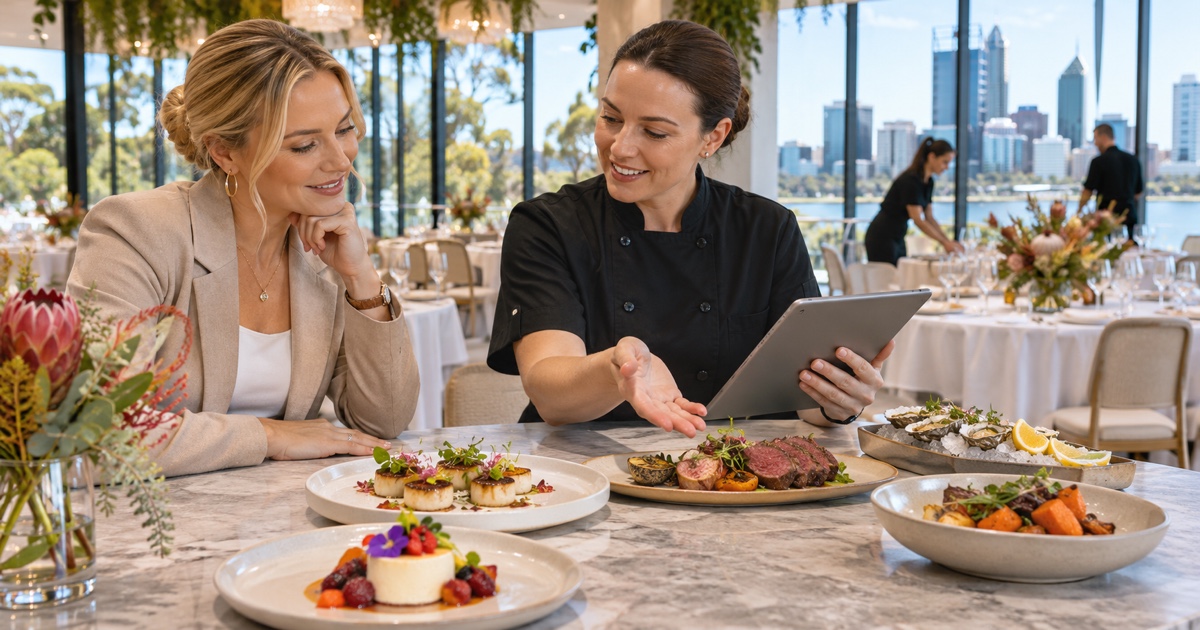
Catering companies Perth clients consider may range from delivery specialists and boutique chefs to full-service event operators. Some focus on a particular cuisine or event size, while others provide staff, bars, equipment and coordination. The right fit depends on the occasion, location and amount of support the organiser needs.
The goal is to choose a company whose operating strengths match the event rather than selecting from photographs or menu descriptions alone. A smaller specialist may be ideal for a focused boardroom experience, while a large event needs deeper staffing, logistics and contingency capacity.
Five Points of Comparison
Relevant Local Experience
Ask for examples with similar guest numbers, service style and venue conditions. Familiarity can reduce uncertainty, but it should not replace a current site check. Venue rules, access and event layouts change, so the company still needs to validate assumptions for the actual date.
Menu and Production Fit
Review whether the menu suits travel, facilities, season and eating window. Confirm where dishes are prepared and finished, how allergies are controlled and what substitutions may occur. The best menu is one the production team can execute consistently at the proposed scale.
Staffing and Supervision
Clarify chefs, service staff, bartenders, setup crew and the supervisor included. Ask about arrival times, breaks, uniforms and overtime. Adequate leadership is particularly important when casual event staff or several service areas are involved.
Equipment and Event Support
List refrigeration, heating, bars, glassware, linen, furniture, service stations, waste and cleaning. Separate items included in the quote from options or venue responsibilities. Missing equipment can create late hire costs and unsafe improvisation.
Communication and Change Control
A reliable company provides deadlines, one planning contact and a current function sheet. Confirm how weather, supplier shortages, staff absence and guest-number changes are handled. The organiser should know who can approve alternatives and additional charges.

Where Comparisons Commonly Go Wrong
- Selecting from social images without testing planning and operational capability.
- Comparing menu prices that contain different quantities, staffing and equipment.
- Assuming a caterer’s familiarity with a venue removes the need for current confirmation.
- Leaving weather and outdoor-service contingencies unresolved for Perth conditions.
- Relying on one organiser to remember changes that never reach the event team.
A Fair Selection Process
- Write one brief: Give each company the same purpose, venue, run sheet, guest estimate, budget and service expectations.
- Compare complete scope: Separate food, labour, equipment, delivery, beverages, travel, cleaning and venue charges.
- Test relevant evidence: Review comparable events, references, dietary systems, insurance and required licences.
- Meet the delivery lead: Confirm who owns planning and who will supervise setup and service on the day.
- Approve the function sheet: Sign off timings, quantities, floor plan, dietaries, contacts and contingencies.
Questions for the Internal Team
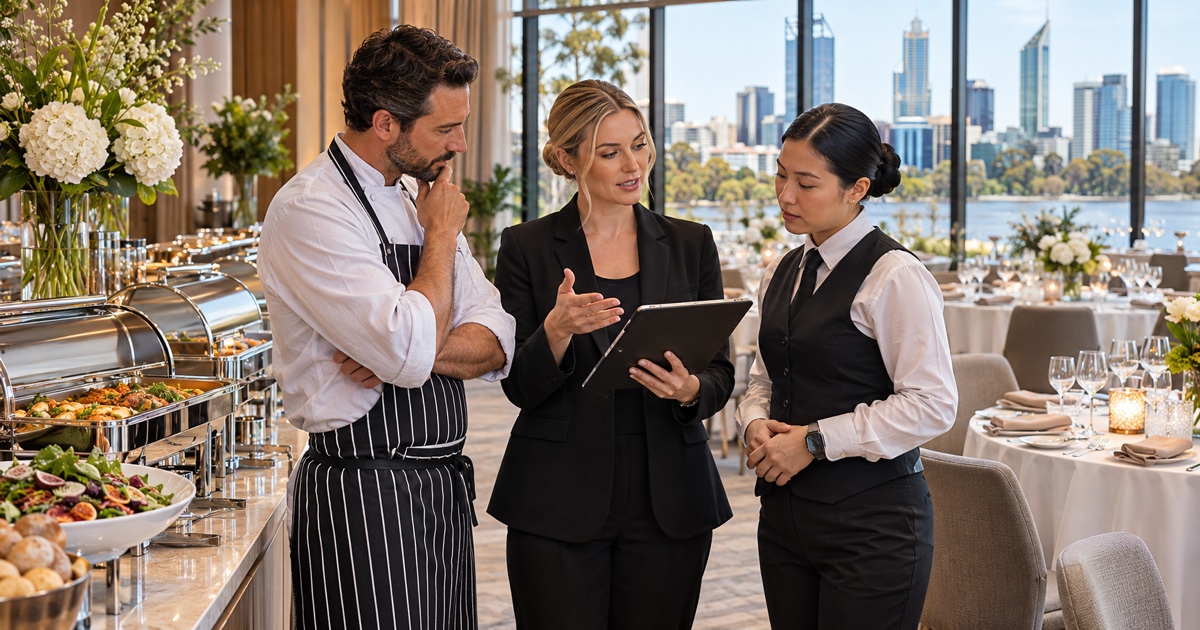
Before committing time or budget, check that the business can answer the following points clearly. A gap does not always stop the project, but it should become an explicit action rather than a hidden assumption.
- The organiser has separated essential service requirements from optional enhancements.
- Venue access, facilities and pack-down rules have been confirmed in writing.
- Each quote can be compared on equivalent food, labour and equipment assumptions.
- Dietary and beverage responsibilities have named owners and clear processes.
- Cancellation, overtime, travel and late-change terms have been reviewed before deposit.
How to Review Value After Appointment
Track response time, proposal accuracy, on-time setup, dietary accuracy, service pacing, food waste, guest feedback and variance between quote and final invoice. Record organiser intervention and issue resolution. For repeat providers, a simple scorecard helps distinguish an isolated problem from a recurring system weakness.
Use the same definitions and review period each time so that the trend is meaningful. Combine financial and workforce measures with a service indicator; an apparent saving is not an improvement if it transfers work to managers, slows delivery or weakens the guest experience.

Choosing a Model That Fits
The best Perth caterer is the one whose food, service model and local operating capability fit the occasion. Aspire Hospitality Group can help plan and deliver corporate and private events with menus, staffing, equipment and logistics designed around Western Australian venues and guests.
Explore Aspire Hospitality Group’s Perth catering and event services and hospitality consulting services for connected support. To discuss the priorities, operating context and next steps for your organisation, contact the Aspire Hospitality Group team.
Frequently Asked Questions
How should catering companies in Perth be compared?
Use one written brief and compare food quantity, staffing, equipment, delivery, travel, service time, dietary systems, experience and terms alongside the total price.
Is a tasting necessary before booking?
A tasting is useful for important plated or canapé events, but it should test portion and practicality as well as flavour. It does not replace checking logistics and service capability.
What does full-service catering usually include?
Scope varies, but it may include chefs, waitstaff, equipment, setup, beverage service, clearing and pack-down. Ask for every inclusion and responsibility in writing.
Why does local venue experience matter?
It can help identify access, equipment and timing constraints early. However, the provider should still confirm current rules and the specific event layout.
What contract terms should be reviewed?
Check deposits, final numbers, cancellation, overtime, travel, breakage, substitutions, minimum charges and the process for approved changes.