
catering company Australia matters when Australian hospitality businesses need decisions that work commercially and operationally. A local caterer may offer strong venue knowledge and flexible relationships, while a national provider may bring consolidated systems and multi-city coordination. Neither model is automatically better. The event portfolio, locations and service risk should determine which strengths matter.
This guide takes a operations playbook approach and also considers national catering company, local event caterer, Australian event catering, multi-location catering and corporate catering coverage. The aim is to connect local conditions with practical action rather than offer a generic checklist detached from the venue.
For catering company Australia, a useful review makes the baseline, intended decision and accountable owner explicit. It also identifies what evidence will be checked after implementation and which guest, workforce or safety measures must not deteriorate in pursuit of a financial result. Managers should record assumptions about demand, labour, supply and timing so that the outcome can be interpreted fairly when conditions change. This discipline keeps the project connected to everyday operations and gives the team a clear reason for each action. It also makes catering company Australia easier to revisit: future leaders can see what was decided, why it was selected and when the standard should be reviewed rather than starting again from memory.
- Frame the Operational Problem
- Five Parts of the Operating System
- Build the Improvement Playbook
- Adapt the Method to the Australian Venue
- Use a Practical Review Rhythm
- Implementation Checklist
- Failure Modes to Design Out
- Make Improvement Repeatable
- Frequently Asked Questions
Frame the Operational Problem
A catering company Australia clients appoint can operate from one regional kitchen, several company-owned facilities or a managed network of local partners. Coverage may include delivery, event staff, equipment, bars and account reporting. Clients need to understand the structure behind the service promise.
The objective is consistent food and service at each event without paying for scale that is not required or accepting local variability that has not been managed. The right model gives the organiser clear accountability while keeping production and event decisions close enough to the actual venue.

Five Parts of the Operating System
Ownership and Delivery Structure
Confirm whether kitchens and teams are company-owned, franchised, partnered or subcontracted. Identify the party responsible for food safety, staffing, invoicing and issue resolution at each location. One account manager is useful only when local delivery ownership is equally clear.
Menu Consistency and Local Flexibility
Decide whether the same menu is necessary everywhere or whether common standards can be delivered through regional ingredients and formats. Controlled local flexibility can improve seasonality and logistics, but substitutions need approval rules and accurate dietary communication.
Capacity and Simultaneous Events
Ask about kitchen throughput, vehicle and equipment availability, staff pools and backup on peak dates. A provider may handle one large event well but struggle with several locations at once. Review the event calendar rather than assessing each booking in isolation.
Account Management and Reporting
For recurring work, define ordering, approvals, change control, consolidated invoicing and performance reporting. Local organisers still need responsive contacts. The model should reduce administration without creating a central queue that slows ordinary event decisions.
Continuity and Contingency
Understand alternative kitchens, supplier backup, staffing coverage and the plan for transport or weather disruption. Regional work may need earlier decisions and different menus. Contingency should be specific to the geography and service, not a general statement in a proposal.

Build the Improvement Playbook
- Map the portfolio: Group events by location, size, frequency, service style and operational risk.
- Set common standards: Define required dietary, food safety, communication, reporting and guest-experience controls.
- Compare operating models: Test local and national structures against the actual portfolio and management capacity.
- Pilot representative work: Run events in different locations and formats before committing the broader calendar.
- Review and scale: Use evidence to refine menus, responsibilities, pricing and local flexibility.
Adapt the Method to the Australian Venue
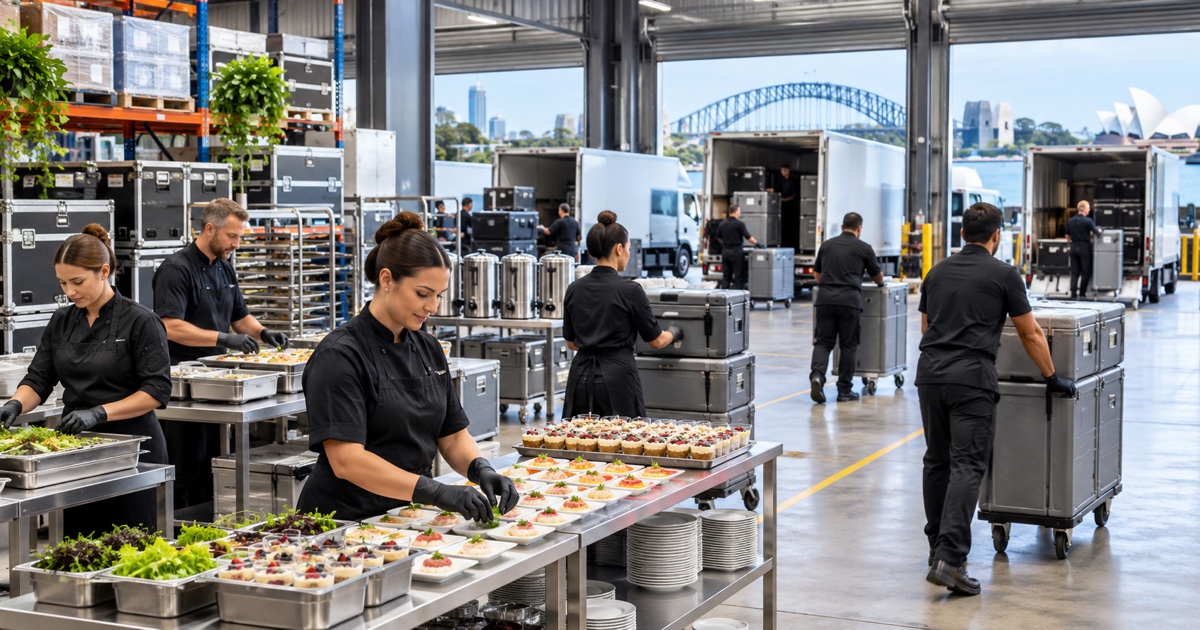
Australian distances, regional supply, labour availability and transport can materially change an event plan. A national menu may not be practical in every location, while a local provider may have limited capacity for simultaneous functions. Multi-location clients also need consistent dietary data, invoicing and brand standards across different venues.
Map the event calendar by city, region, size and service type. Decide which standards must be identical and where local produce or format can vary. Ask national providers how local delivery is governed and ask local companies how they manage peaks, travel and continuity. Pilot the model at representative locations before wider appointment.
Use a Practical Review Rhythm
Track on-time delivery, setup, dietary accuracy, guest feedback, waste, issue resolution and invoice variance by location and event type. For national programs, compare local performance and central account response. The reporting should identify where adaptation is needed rather than only presenting an overall success rate.
Use the same definitions and review period each time so that the trend is meaningful. Combine financial and workforce measures with a service indicator; an apparent saving is not an improvement if it transfers work to managers, slows delivery or weakens the guest experience.

Implementation Checklist
Before committing time or budget, check that the business can answer the following points clearly. A gap does not always stop the project, but it should become an explicit action rather than a hidden assumption.
- The organisation knows which events need one provider and which can use local specialists.
- Common standards are separated from menu or service elements that may vary by region.
- The provider has identified the real production and supervision model for every key location.
- Reporting and invoicing requirements are proportionate to the event volume.
- Representative pilots include both metropolitan and regional or complex delivery conditions.
Failure Modes to Design Out
- Buying national coverage when most events occur in one local market.
- Assuming one brand guarantees identical kitchens, staff and controls across locations.
- Forcing a uniform menu where local supply and transport make quality difficult.
- Using separate local providers without common dietary and reporting standards.
- Scaling before testing simultaneous events and regional contingency.
Make Improvement Repeatable
Local and national catering models can both succeed when coverage, standards and accountability are transparent. Aspire Hospitality Group can support Australian event programs with practical catering, workforce and consulting capability, including Western Australian delivery and coordination for wider operating needs.
Explore Aspire Hospitality Group’s Australian catering and event services and hospitality and event consulting for connected support. To discuss the priorities, operating context and next steps for your organisation, contact the Aspire Hospitality Group team.
Frequently Asked Questions
Is a national catering company cheaper than local providers?
Not necessarily. Compare total food, labour, travel, equipment, account management and internal administration. Scale creates value only when the portfolio uses it.
Can one menu be used across Australia?
Core standards can be shared, but regional availability, travel and kitchen capability may justify controlled variations. Dietary information must remain accurate.
How should national coverage be verified?
Ask who owns production and service in each location, review comparable examples and pilot representative metropolitan and regional events.
When is a local catering company preferable?
Local providers may offer strong venue knowledge, seasonal sourcing and flexible relationships when events are concentrated in one market or need specialist style.
What should multi-location reporting include?
Include delivery, service, dietaries, incidents, waste, guest feedback, quote-to-invoice variance and actions, with results visible by location.